You have a problem right now that nobody knows about.
Maybe it's money. A statement you've stopped opening. A payment that's a week late and about to be two. Maybe it's the job, the one you walk into every morning telling yourself it's temporary, three years in. Maybe it's the business that stalled six months ago, which you've been calling a slow season. Maybe it's at home, a conversation you've been avoiding so long that avoiding it has become the relationship. Maybe it's your body, the appointment you keep moving and the sleep you keep promising yourself. Maybe it's nothing you can point to, just the feeling, every time you pick up your phone, that every other man is ahead of you. You know which one it is. You thought about it this morning before your feet hit the floor, and you didn't say a word about it at dinner.
If that's you, you're in a bigger room than you think. A 2025 national survey of American men found that more than half say "no one really knows me" (Equimundo). Most of those men aren't hiding a secret life. They're hiding a problem.
Here's what I know about that problem without knowing anything else about you: it's getting more expensive while you read this sentence.
Problems don't hold their size. A bad job you never dealt with turns into a missed car payment. The missed car payment turns into missed rent. And one day, God forbid, the bad job you never dealt with turns into not being able to pay for your mother's heart surgery. People tell me their problem is small. They're usually right about today and wrong about everything after it. Don't rank your problems by how they look right now. Rank them by what they'll turn into if you leave them alone.
That's the part nobody tells a man, and it's why so many men who look fine on the outside are quietly going broke, quietly losing the people they love, and quietly running out of time to do anything about either. Not because they're weak. Because they were never taught what to do with a problem except hide it.
Handle it yourself. Don't complain. Don't let them see you sweat. That's the training. So you hid them, one on top of another, until something gave, and when it gave, the people around you said you overreacted, and you believed them. You're not alone in that. The research on help-seeking keeps finding the same thing: men are less likely than women to ask for help, across race, age and social status (Journal of Advanced Nursing), and less likely to turn to family and friends when something goes wrong (PMC). We were raised to treat problems as something to survive. Nobody taught us to use them.
If You've Already Tried
Maybe you're not the man who hid the problem. Maybe you're the man who went after it, more than once, and you're reading this tired.
You restarted the business. You read the books and did what they said. You had the conversation at home, more than once, with every tool you knew, and the same silence came back. You changed jobs and found the same ceiling in the new building. You told yourself this was the year, and the year is most of the way gone. Your body is tired in a way sleep doesn't fix, and somewhere in there you started to suspect that a man who has tried this hard and is still here just doesn't have it.
I want to put a different word on what's happened to you, because the word you've been using is wrong. You're not stuck. You're not weak, and you didn't run out of talent. You're in deficit.
Problems pay in every currency a man has. Money, yes, but also his mind, his mood, his body and his sense of who he is. Every problem you carried without collecting on it charged you in sleep. It charged you in patience, so there was less of it for the people at home. It charged you in energy, so every new attempt started with less than the one before. It charged you in confidence, in ideas, in the way you walk into a room. Years of that add up to exactly what you're feeling: a man who has worked harder than almost anyone he knows, with less to show for it than he should, broke in a currency nobody taught him to count. That's why it feels like exhaustion and not like a bill.
A man in deficit looks like a man who gave up. He isn't. He's paid full price on every problem for years and never once collected, and the most expensive line on that ledger isn't the money. It's the man he became while paying, the one who stopped believing in the version of himself he could see when he was younger. That version isn't gone. He's unpaid.
I'm telling you this now instead of saving it for the end, because a deficit built one problem at a time comes back the same way. The first problem you handle instead of carry doesn't fix your life. It moves one line on the ledger from paying to collecting, and that's the first time in years something has paid you back. The second is easier, because you've collected once.
I won't promise you that your life changes in twenty-four hours. The years were the deficit, and collecting on them takes longer than a day. But the direction of a life can change in twenty-four hours. Mine did, and nothing about my circumstances was different at the end of that day except which way I was facing. I'll tell you about it in Chapter 5. The deficit took years. The turn took a day.
I'm going to teach you to use your problems instead of surviving them. The whole method fits in one sentence. The rest of this book exists to make sure you can never unhear it.
The Rule
Every problem has a price, and every problem pays.
The price is what the problem costs you right now, whether you see it or not. The payment is what you collect when you handle it the right way: information, understanding, a second chance you built yourself, and eventually money, time and respect.
You can't opt out. You're either paying the price or collecting the payment. There's no third option where the problem politely waits for you. Every day you carry a problem without handling it, you're paying. Every time you handle one properly, you collect. Which means the single reason most men never get the life they scroll past every night isn't talent, money or luck. It's a stack of unhandled problems standing between them and it, each one quietly charging interest.
There's a word for the price you keep paying without ever collecting, and I want you to start using it: debt. A problem you don't handle isn't sitting still. It's a loan you never signed for, at a rate you didn't negotiate, and the interest is the chain you just read: the bad job that becomes the missed car payment that becomes the missed rent. Carry a problem and it charges you interest. Collect on it and it pays you. Those are the only two columns on the ledger, and every problem you have is in one of them right now.
And here's the part most men miss even after they start handling things: solving a problem and collecting on it aren't the same thing. If you fix it and learn nothing, patch it and move on, or file the lesson without letting it change you, you've paid the price and walked away from the payment. That's still debt. It just doesn't look like it until the same problem comes back with the same bill.
It doesn't always have to be about money. Sometimes the payment is time back. Sometimes it's a relationship that didn't break. Sometimes it's just the man you become by not running. But I'm going to talk about problems like they have dollar signs attached, because that's the fastest way I know to make a man take one seriously.
What You'll Walk Away With
By the last page you'll know how to do things most men never learn:
- Say one word in the two seconds after bad news that keeps you in control of it.
- Say a problem out loud, to the right person, so it stops growing in the dark.
- Stop waiting for the promotion, the check or the person who's going to fix it, because nobody is coming, and that's good news.
- Spot the kind of calm that's actually a warning.
- Read a problem for what it's telling you, find its root, put a real price on it, and know when the right move is to walk away from it before it starts charging you.
- Stand where the information is instead of where the report is.
- Make the smallest move into uncertainty, and fix things so they stay fixed.
- Bring hidden problems into the light on your schedule, before they burn the house down on theirs.
- Let a lesson hurt enough to stick, so you don't pay for it five times.
- Use the exact same skill at home, at work and on problems far bigger than your own.
And you'll know what happens if you don't. You already do, actually. You've watched it happen to men around you. The one who's still "about to" start. The one whose business died of a problem he saw two years before it killed him. The one who lost his marriage to a conversation he never had. None of them was stupid. None of them was lazy. Every one of them was carrying problems he'd never been taught to collect on, and paying interest on every one of them.
Why Listen to Me
I'm not writing this from a distance. I came to this country as a refugee kid who learned English before his parents and translated their lives for them. I made my first dollar at thirteen, worked a hotel front desk through high school, dropped out of college and quit my job in the same twenty-four hours, and failed at venture after venture before any of them worked. I maxed out my credit cards on one of them and was left with nothing. I've stood in a restroom minutes before signing a deal, having just learned the money behind it was gone, and had to decide what my face would do when I walked back in.
Then I learned how problems pay, and everything changed. Today I spend my time on problems much bigger than my own, as an advisor on innovation and economic growth to an international council working on United Nations Sustainable Development Goals 8 and 9, the ones about decent work and the infrastructure that lets a man with a good idea and no collateral actually start. That's the end of this book, and the point of it: once you learn to collect on your own problems, you get to collect on other people's. There's no bigger payoff.
You'll get pieces of my story along the way, but only the pieces that prove a point, and never for long. I'd rather you spend your time on your problems than on my past.
How This Book Works
Four parts, thirteen chapters, one idea per chapter. I kept them short on purpose. A man with a problem doesn't need a lecture. He needs the next move.
Part One, The Reaction, covers the first two seconds and the first few days: what you say when a problem shows up, why you hide it, why waiting to be rescued doesn't work, and why calm can be more dangerous than chaos.
Part Two, The Reading, teaches you to read a problem: find the root, put a real price on it, and go stand where the information is.
Part Three, The Response, is about action: the smallest move, rebuilding instead of patching, and bringing hidden problems into the light before they pick their own moment.
Part Four, The Transfer, makes it stick and makes it bigger: how to keep a lesson, how to use the same skill at home as at work, and what happens when you point it at problems larger than your own.
Running through all of it are six moves, and you'll learn them one at a time:
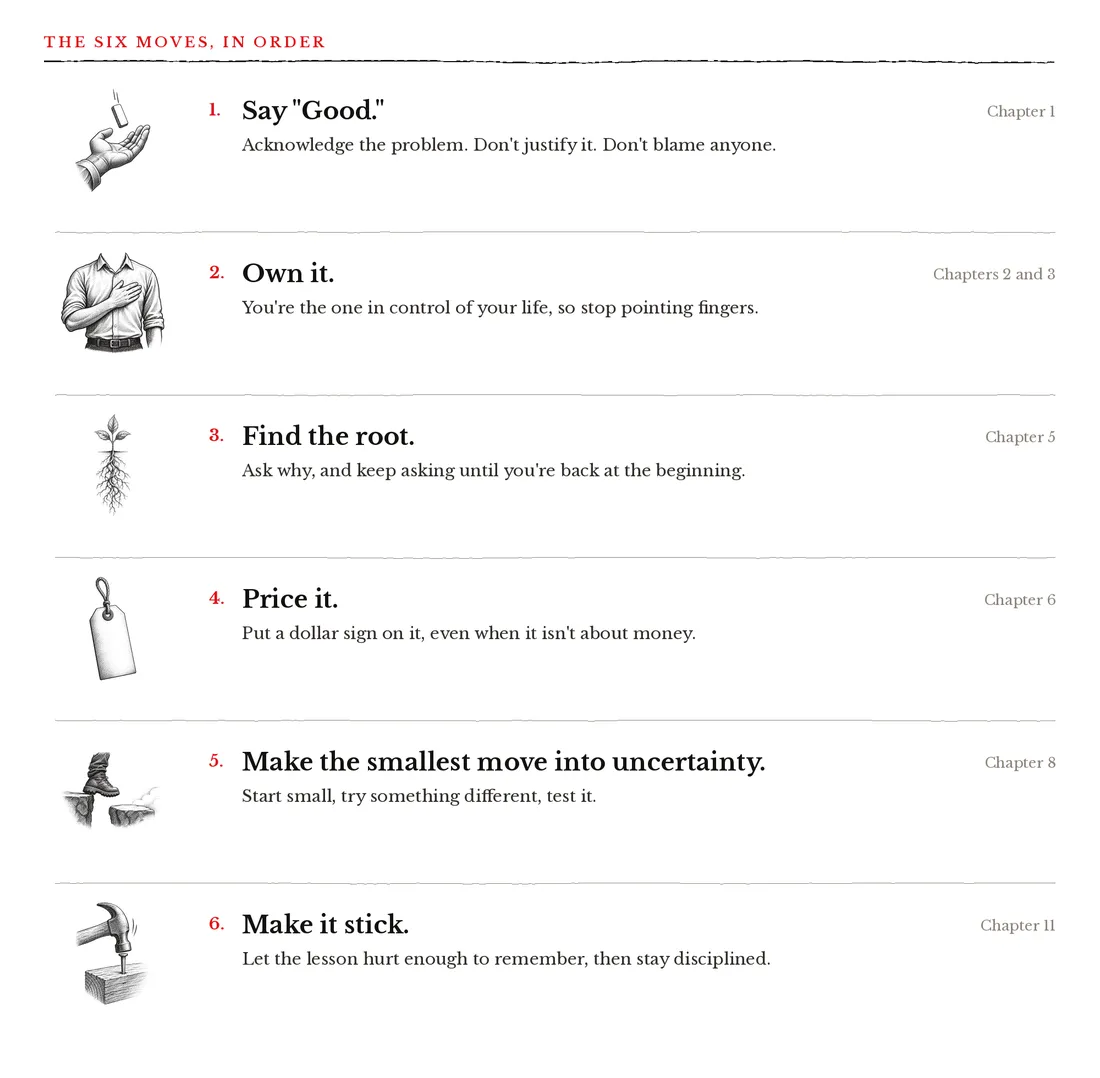
- Say "Good." Acknowledge the problem. Don't justify it. Don't blame anyone.
- Own it. You're the one in control of your life, so stop pointing fingers.
- Find the root. Ask why, and keep asking until you're back at the beginning.
- Price it. Put a dollar sign on it, even when it isn't about money.
- Make the smallest move into uncertainty. Start small, try something different, test it.
- Make it stick. Let the lesson hurt enough to remember, then stay disciplined.
Right after this introduction is one page with the Rule and thirteen rules for keeping it, one per chapter. It's the page you'll come back to when the next problem lands, so you don't have to start the book over.
Every chapter ends the same way: the ledger for that chapter's problem, with the debt in one column and the payment in the other, then one line to say out loud, and one thing to do today. Not a worksheet. Not a thirty-day program. One thing. I've watched too many men build a fifty-step plan and never take step one. And one honest note before we start: if what you're carrying is depression, anxiety or anything medical, get professional help. That isn't weakness. That's taking responsibility, which is the whole point of this book.
Some of what I'll ask you to do will feel wrong the first time. Saying "Good" when something goes bad. Saying a problem out loud. Walking toward the uncertain option when the comfortable one is right there. That discomfort isn't a sign you're doing it wrong. Usually it's the sign you're doing it right.
Problems pay. The sooner you learn how, the sooner you collect.