RULE 01 OF 13 · PART 1: THE REACTION
Say "Good."
One word in the two seconds after bad news keeps you in control of it.
WHERE YOU ARE · MOVE 1 OF 6: SAY "GOOD."
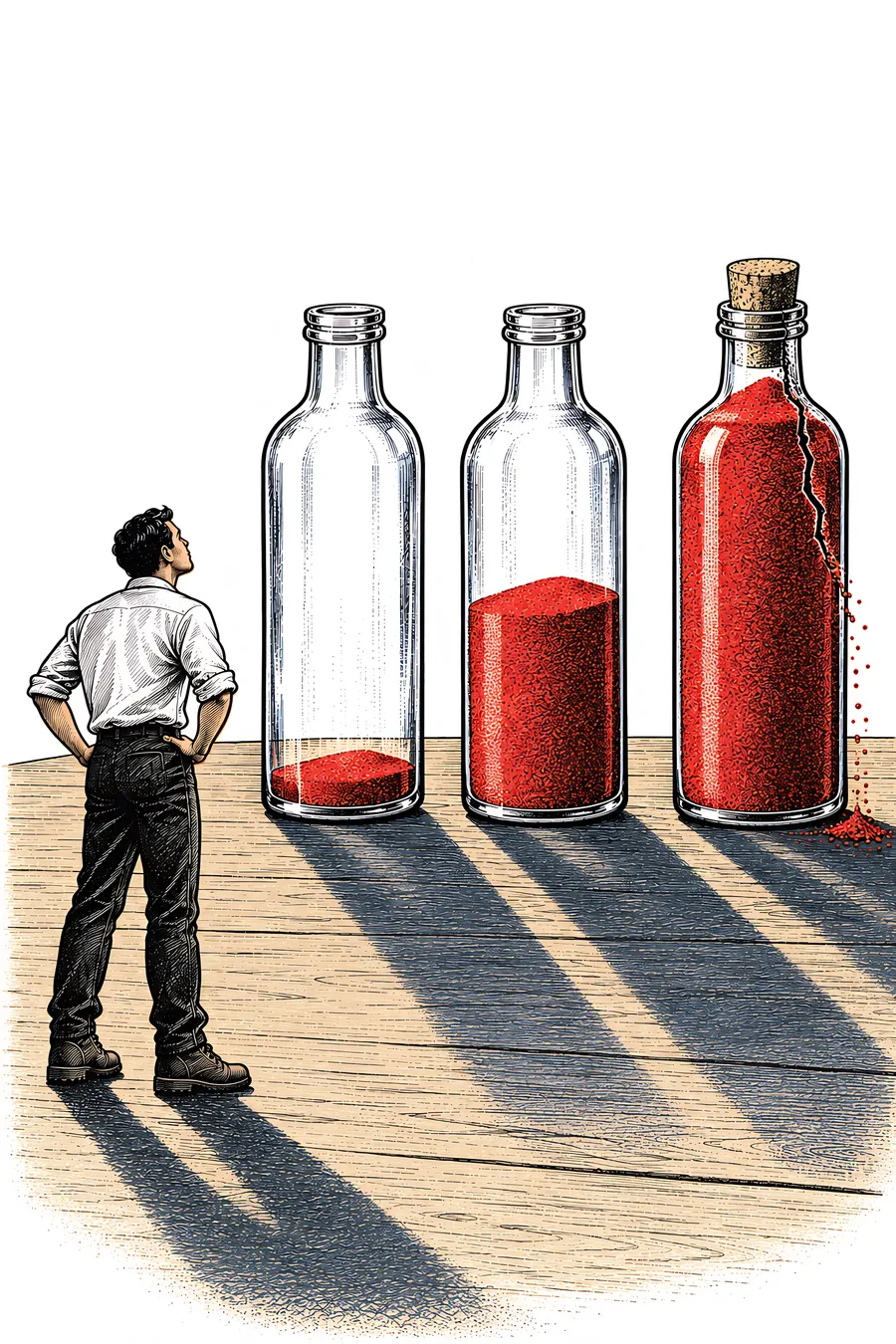
Every problem you don't deal with is a little sand poured into a bottle.
A late payment. A conversation you keep putting off. A partner you stopped trusting six months ago but never said so. The sand doesn't make noise going in, and that's the trouble. When a man finally blows up over something small, he isn't reacting to the small thing. He's reacting to everything underneath it.
Rule 1 is about the two seconds after a problem lands. That's where you decide whether it charges you or pays you. Most men spend those two seconds on blame, on explaining, on whose fault it was. Blame buys nothing. One word does.
"Good" doesn't mean you're happy about it, and it doesn't mean the problem is small. It means you've acknowledged it, you won't justify it and you won't blame anyone. Then you stop for one breath and make the next right move. Chapter 1 shows you the four ways men meet a problem, why bad news at night hits harder, and how to say the word before you believe it.
CHAPTER 1 · THE FOUR WAYS A MAN MEETS A PROBLEM
Be honest about which one you are.
01 · DEBT
He hides it.
Paints a picture for everyone around him and lives inside the picture. Now there's a second problem: the hiding.
02 · DEBT
He carries it.
Doesn't lie about it, doesn't deal with it. Puts it in the bottle. It feels like strength. It's sand.
03 · PRICE PAID
He patches it.
Does the quickest thing that makes it stop making noise. The patch holds, then falls off, and the problem comes back bigger.
04 · COLLECTED
He collects on it.
Acknowledges it, owns it, finds the root, prices it, makes a move and makes the lesson stick. The problem pays him.
THE RULE, AGAIN
Every problem has a price, and every problem pays.
NOBODY GETS TO NOT PAY. YOU ONLY GET TO CHOOSE THE COLUMN.
SAY IT OUT LOUD
Good. I'm glad it happened.
The next time bad news lands, say "Good," out loud or in your head, and stop there for one breath. No blame, no explanation, no story about whose fault it was. Just the word, then the next right move.
THE NEXT MOVE
The full chapter is in the book.
The stories, the objections and the teaching behind Rule 1 are in Chapter 1 of Problems Pay.